5 Essential Knots Everyone Should Know for Outdoor, Survival, and Everyday Use

Erik Kulick · May 8, 2026
With just five simple knots you can handle nearly any outdoor situation with confidence.
When it comes to outdoor skills, knot tying is one of the most useful you can learn — whether for a relaxed camping trip or a stressful wilderness emergency.
But here’s the mistake many people make — they overcomplicate the learning process. They believe that they need to learn 101 different knots for 101 different applications.
You don’t.
You need only know a few – provided you can tie them confidently and understand some basic principles.
In our wilderness survival classes, we teach just five knots.
Because with those five you can do 101 different things.
If you’d like a visual walkthrough, you’ll find our accompanying video at the end of this article.
Why Knots Matter in the Outdoors
In the outdoors, knowing how to tie knots can be useful – securing loads, setting up a tent, or hanging gear. Just to name a few.
In a wilderness emergency, knots can be lifesaving – helping you build a shelter, start a fire, or signal for help. Just to name a few.
So how many knots should you know?
That depends on your personal preferences and chosen activity. For car campers and hikers, maybe just one or two. For rock climbers and sailors, quite likely a lot more.
But for general outdoor use, five is enough.
Those five are:
- Timber Hitch
- Butterfly Knot
- Slip Knot
- Trucker’s Hitch
- Clove Hitch
We teach these knots — and rely on them ourselves — because they are:
- simple to learn
- easy to untie
- and highly versatile
In the end, simplicity works best – especially when conditions are not ideal.
Before You Start Practicing
Before diving in, there are three things worth keeping in mind.
First, don’t get frustrated if your knots don’t come out perfectly at the start. Even simple knots take time to learn. You need time to understand the process — and then more time to build the muscle memory so it feels natural in your hands.
Second, knot tying is a perishable skill. Even if you learn these today, you won’t retain them without practice. And under stress — not to mention cold, fatigue, or injury — fine motor skills and the ability to think clearly degrade quickly. Regular practice matters.
Third, there are many ways to tie each of these knots. The methods we teach are based on experience — chosen because they are easy to learn, reliable in harsh conditions, and work well together as a system.
For practice, use a length of cord about four to five feet long. 550 cord — paracord — works particularly well.
Timber Hitch
The Timber Hitch isn’t glamorous — but it’s one of the most practical knots you can know.
It’s used to attach a rope to an object, typically a tree or pole. It’s quick to tie, holds well under steady tension, and is even easier to untie — even after being heavily loaded.
Its strength comes from consistent, directional tension — not shifting or intermittent loads.
Traditionally used in forestry by sawyers, it remains a go-to for dragging timber, hoisting poles, starting lashings, or building shelters.
Butterfly
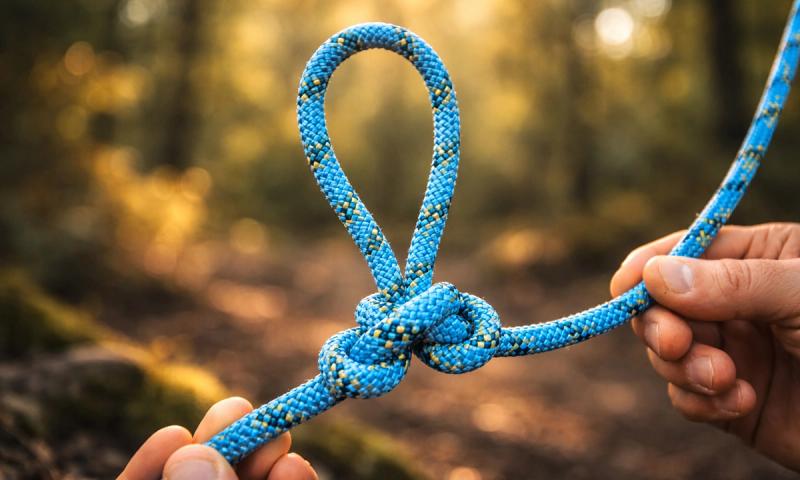
The Butterfly – sometimes called the Alpine Butterfly – allows you to create a secure loop at any point along your line and in virtually any size.
It’s strong, stable under load, and relatively easy to untie.
That “relatively” matters — if heavily loaded, it can take finesse to loosen, but it can be done. So it remains one of the most dependable midline loop knots available.
Use it anytime you need a fixed loop for rigging, hanging gear, or creating an attachment point — especially as part of systems like the Trucker’s Hitch.
Slip Knot
The Slip Knot creates a quick-release loop that tightens under load and can be released easily by pulling the free end.
It can be tied midline or at the end of a rope and is best suited for temporary applications where speed and adjustability matter.
It works well for bundling items or creating a simple tensioning point in a system — like securing the line of a rain-fly to a stake and keeping it taut.
Truckers Hitch
The Trucker’s Hitch is a classic for a reason.
It’s a powerful, self-binding system used to secure loads on trucks, trailers, and roof racks — hence the name.
Its key advantage is mechanical leverage — it allows you to apply significant tension to a line before locking it off.
The version we teach combines the three knots already mentioned — the Timber Hitch, Butterfly, and a variation of the Slip Knot — into one efficient system.
It’s ideal for securing loads or creating a taut ridgeline for a shelter.
Clove Hitch
The Clove Hitch is used to attach a rope to a post, pole, or other cylindrical object.
It’s quick to tie and untie, which makes it useful for lashing and temporary securing.
However, it performs best under consistent tension. If the load shifts or becomes intermittent, it can loosen.
For that reason, avoid relying on it for critical or long-term applications unless you back it up with an additional knot.
Remember to Keep It Simple
Those are the five.
Not 101 knots — just five you can tie confidently, consistently, and without hesitation.
If you take the time to practice them, you’ll find they cover far more situations than you might expect — from everyday camp tasks to unexpected emergencies.
At True North, we emphasize this kind of practical competence — simple skills, well practiced, that hold up when conditions are less than ideal.
If you want to build real confidence with these knots, take the time to practice them — and if you’d like structured guidance, you can check out our Wilderness Survival Program at True North.
Meet the Author

Erik Kulick, Founder & Chief Instructor
Erik is a Pennsylvania-certified EMS Instructor, Fellow of the Academy of Wilderness Medicine, and served in law enforcement. He works with individuals and groups across all skill levels -- from beginners to members of the SOF community. He's been featured in national and international media, including CNN, The Associated Press, Backpacker, and The Guardian.
To learn more about Erik, visit him on LinkedIn and be sure to follow him on Facebook, Instagram, and YouTube.