How to Choose a Survival Knife: Your Most Important Tool in an Emergency

Erik Kulick · Dec 22, 2025
A knife is key to any survival kit or go-bag. Choosing the right one can be daunting. Here are some considerations on how to choose a survival knife.
A survival knife is a fundamental component of any survival kit or go-bag — so essential, in fact, that a kit without one is effectively half empty. While other tools and supplies may still be useful on their own, the absence of a knife will significantly limit your ability to use them to their full potential.
A knife serves as a cornerstone survival tool in nearly every emergency scenario, enabling a wide range of life-saving tasks. If I were forced to choose just one item to rely on in an emergency, it would be a knife.
Choosing the right survival knife, however, can feel daunting. The market offers an almost endless selection designed to meet a wide range of preferences, budgets, and perceived needs. In truth, most knives will work — but some are far better suited for emergencies than others. You should choose your survival knife as if your life depended on it — because one day, it just might.
In this article, I’ll explain how to choose a survival knife that fits your needs, intended use, and budget. I’ll also share two survival knife recommendations that I personally use and trust.
For those who prefer a visual walkthrough, the full instructional video is included below.
We Get No Kickbacks (Why Our Recommendations Are Impartial)
It’s important to begin by making something clear: neither True North nor our staff receive kickbacks, compensation, or incentives of any kind for the products we mention. We do not use affiliate links, accept commissions, receive payments, or take free products from manufacturers.
Most importantly, True North does not sell gear. Our gear and product recommendations — both online and in our training courses — are completely impartial.
Our goal is simply to guide people toward equipment that we personally use and trust. While it may sound cliché, the core of our mission at True North is to train and advise others as if they were members of our own family.
Why a Survival Kit Without a Knife Is “Half Empty”
I began by stating that a survival kit or go-bag without a knife is half empty, so let me explain why.
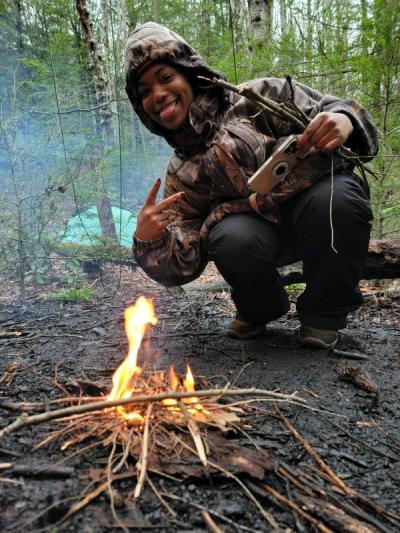
One of the core survival priorities in any emergency is the ability to make fire. Fire serves many purposes: it allows you to boil water to make it safe to drink, keep warm to maintain health and function, signal for help, and — just as importantly — maintain morale.
In many ways, the other survival priorities are closely linked to fire.
Most survival kits include a fire starter and some form of tinder, either natural or manufactured. Getting a flame is a good start — but without a knife, how do you turn that flame into a sustained, effective fire?
With a knife, you can cut, gather, and process kindling and fuel efficiently. Without one, the task becomes slower, more difficult, and far more energy-intensive. While it may still be possible, response time is increased and effort is multiplied.
In an emergency, why make an already difficult situation even harder?
Key Considerations When Choosing a Survival Knife
When selecting a survival knife for your kit or go-bag, keep the following factors in mind.
Choose a Fixed-Blade Survival Knife
A fixed-blade survival knife allows you to get to work immediately when you need it most.
I carry a folding knife every day and often keep a multi-tool handy. These tools are useful for routine outdoor tasks and everyday convenience. However, I view them as supplementary tools, not primary survival tools.
In cold conditions, when fine motor skills are compromised, opening a folding knife can become difficult. The same is true if you’ve suffered an injury, such as a broken arm or damaged hand. A fixed blade is ready the moment you draw it — no extra steps required.
Yes, folding knives can still be used in these situations. But again, why make a difficult situation harder than it needs to be?
Why a Full-Tang Knife Matters
Your survival knife should ideally be full tang, meaning the steel runs from the tip of the blade all the way through the handle.
This construction greatly reduces the risk of failure under stress. In a survival situation, your knife may be used for far more than simple cutting. Tasks may include digging, chopping, batoning, pounding, or light prying.
While partial-tang and folding knives can perform some of these tasks, they are far more likely to break under sustained or abusive use. Reliability matters most when conditions are harsh and help is far away.
Bigger Doesn’t Mean Better
You do not need a machete or an oversized “military-style” knife with a 14-inch blade.
Large knives are often impractical: they are heavier, harder to pack, more difficult to control, and increase the risk of serious injury. In an emergency, the last thing you want is to worsen your situation with a deep laceration or amputated finger.
The blade on my primary survival knife is just over four inches long. I am fully confident that it will meet my needs in an emergency.
You Don’t Need to Spend a Lot of Money
Many so-called survival knives are priced near $200 — or far more. While some of these are excellent tools, there are plenty of equally reliable and well-made options available for under $100, and even closer to $25.
A functional, dependable survival knife does not need to be expensive. What matters most is thoughtful design, solid construction, and suitability for real-world use.
Two Survival Knife Recommendations We Trust
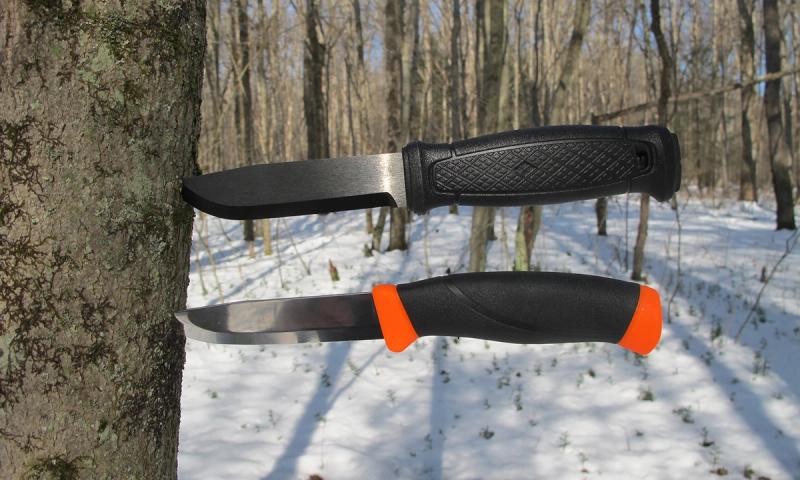
The following two knives are made by the same manufacturer, Mora, and represent reliable options at two different price points. Both meet the criteria outlined above and are knives that I personally use and trust.
Mora Companion (Affordable Survival Knife Option)
- Blade length: 4.1 inches
- Overall length: 8.5 inches
- Blade material: Stainless steel
- Price: Around $25
The Mora Companion is one of the best values available in a fixed-blade survival knife. Its stainless-steel blade is easy to sharpen and far less prone to corrosion than carbon steel, making it a low-maintenance option.
It reliably handles common survival tasks such as processing wood for tinder and fuel, basic shelter construction, and food preparation. While the Companion is technically a three-quarter tang rather than a full tang, this is a justified exception. It is exceptionally robust and has proven its durability over decades of real-world use.
The Mora Companion has earned a permanent place in my own survival kit, which is why I regularly recommend it to clients.
At this price point, it’s realistic to stage multiple knives — one in your survival kit or go-bag, one in your vehicle, and one at home.
Mora Garberg Carbon (Heavy-Duty Survival Knife)
- Blade length: 4.3 inches
- Overall length: 9 inches
- Blade material: Carbon steel
- Price: Around $90
The Mora Garberg Carbon is a more heavy-duty survival knife and has become my standard outdoor blade.
Its full-tang construction provides excellent strength and reliability for demanding tasks such as batoning, chopping, and sustained use in harsh conditions. Carbon steel requires more care than stainless steel — it is more prone to rust and should be wiped down and lightly oiled — but it typically holds an edge longer and performs exceptionally well under hard use.
For those willing to maintain it properly, the Garberg offers outstanding durability and performance.
My only criticism of both knives is their factory sheaths. While functional, they are aesthetically unappealing and do not attach to a belt in the way I prefer. Fortunately, this is a minor issue and easily addressed with aftermarket sheath options. It does not detract from the performance or reliability of the knives themselves.
Final Thoughts: Choosing the Right Survival Knife
A knife is not just another piece of gear — it is a foundational survival tool that supports nearly every survival priority.
While the market offers countless options, choosing the right survival knife does not require chasing trends, gimmicks, or high price tags. It requires an honest assessment of how you plan to use the tool, your budget, the conditions you may face, and how reliably the knife will perform when things go wrong.
A well-chosen survival knife, combined with proper training and practical skills — like those that you can learn in our Wilderness Survival courses — can dramatically improve your ability to solve problems, conserve energy, and maintain control in an emergency.
Choose thoughtfully. Carry it consistently. Practice using it.
When it matters most, you’ll be glad you did.
Meet the Author

Erik Kulick, Founder & Chief Instructor
Erik is a Pennsylvania-certified EMS Instructor, Fellow of the Academy of Wilderness Medicine, and served in law enforcement. He works with individuals and groups across all skill levels -- from beginners to members of the SOF community. He's been featured in national and international media, including CNN, The Associated Press, Backpacker, and The Guardian.
To learn more about Erik, visit him on LinkedIn and be sure to follow him on Facebook, Instagram, and YouTube.