The Secret to Land Navigation at SFAS: There Are No Secrets

Erik Kulick · Jun 4, 2026
Preparing for SFAS? Learn why success in land navigation comes from mastering the fundamentals, not searching for shortcuts.
For many Special Forces Assessment and Selection (SFAS) candidates, land navigation is one of the most intimidating aspects of the course. Stories about difficult terrain, long distances, fatigue, and uncertainty have become part of the lore surrounding it.
After all, land navigation is its leading cause of failure.
Which is why many candidates look for an edge by seeking out shortcuts, insider tips, and supposed "secrets" to success.
The reality, though, is that success in SFAS land navigation is rarely determined by tricks, or even natural talent. It comes down to strong fundamentals, sound judgment, and confidence built through deliberate practice.
Understand What Is Actually Being Evaluated
A common mistake is viewing land navigation as simply a test of technical skill and knowledge.
It is … But not really.
While technical proficiency matters, land navigation is ultimately a test of decision-making.
Candidates must be able to follow a route while managing fatigue, dehydration, hunger, uncertainty, and time pressure. And they must make lots of choices along the way.
As a result, the land navigation phase evaluates several attributes simultaneously:
- Attention to detail
- Planning and preparation
- Decision-making
- Discipline
- Confidence
- Physical and mental endurance
Selection cadre understand that candidates will encounter problems. What often separates successful candidates from unsuccessful ones is not whether problems arise, but how they respond when things go sideways.
The candidate who remains calm, reassesses the situation, and methodically solves the problem is typically more successful than the candidate who becomes frustrated and starts making emotional, even panicked, decisions.
The good news is that you can develop these attributes before arriving at Camp Mackall.
The more comfortable you become using a map and compass in realistic conditions, the more mental bandwidth you'll have available for decision-making, problem-solving, and leadership when conditions become demanding.
So don’t view the land nav phase as an obstacle. Rather, embrace it as an opportunity to prove that you have what it takes to be an elite warrior.
Master the Basics
Over the years, I've worked with many candidates who sought my training after failing the land navigation portion of SFAS. A common theme is that they invested significant effort looking for an edge through tricks, shortcuts, or insider knowledge, while underestimating the level of preparation required before arriving. As a result, many never fully mastered the basics upon which successful performance depends.
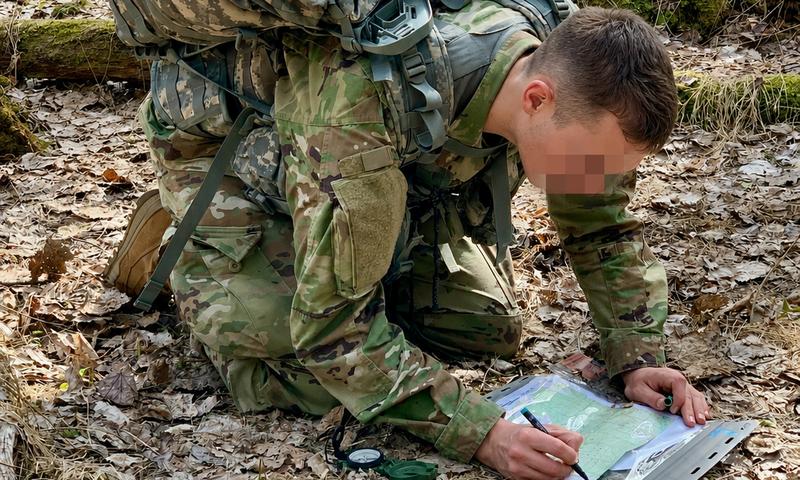
Before worrying about sophisticated route planning or terrain association concepts, ensure you can consistently perform the following fundamental tasks:
- Plot grid coordinates accurately — Why begin your route with even a 1–2 degree error before you leave your position?
- Determine accurate azimuths — Why add an additional 1–2 degree error on top of bad plotting?
- Measure distance effectively — Not just along straight routes, but along curved and irregular routes as well.
- Dead reckon confidently — At least 500 meters under a variety of conditions.
- Minimize drift while maintaining your intended direction of travel.
- Pace count accurately — In all types of conditions and situations.
- Maintain situational awareness — Regularly orient your map; identify terrain features; and track your position.
- Develop a disciplined search plan — You will not always walk directly onto your checkpoint, but you also do not want to waste valuable time searching for it.
These fundamentals must become second nature. They may be simple, but successful performance often depends on executing simple tasks consistently and correctly.
Keep in mind that some of these key skills don’t need to be practiced in the field. Several can be practiced in your dining room while sitting at the table after a day at work.
Don’t make the mistake of waiting until 30 days before your rally date to start preparing. Land navigation is simple in concept but requires time and practice to develop true competence. Just as you wouldn’t expect to achieve the required level of physical fitness in a month, you shouldn’t expect to develop strong map-and-compass skills in that timeframe either. Start at least six months in advance if possible — and ideally a year.
Later at assessment, when fatigue sets in, stress increases, and visibility decreases, candidates naturally fall back on their level of training.
Strong fundamentals create consistency under pressure.
Learn to Terrain Associate
While dead-reckoning remains an important tool in your toolbox – that too many overlook or dismiss – the fact is, the ability to terrain associate is paramount.
Terrain association involves understanding how natural and human-made features — such as ridges, draws, saddles, streams, roads, and structures — relate to your position and intended route. Rather than relying solely on a compass, successful navigators use these features to confirm their location, guide their movement, and make sound navigation decisions with increased speed.
After all, there simply won’t be enough time to reach every checkpoint by relying exclusively on dead reckoning. As distances increase and terrain becomes more challenging, the ability to efficiently interpret and use the landscape becomes increasingly important.
In my view, candidates who can effectively combine dead-reckoning with terrain association are often able to move faster, maintain greater situational awareness, and make better navigational decisions under pressure.
Develop a Deliberate Planning Process
Confident navigation begins long before the movement starts.
Before departing a point, good navigators typically:
- Study the entire AO
- Note major terrain features
- Determine handrails & backstops – Have at least one of each; ideally two of each
- Identify potential hazards
- Develop contingency plans
This planning process helps reduce uncertainty by helping to keep you oriented. This minimizes the likelihood of major navigational errors.
A few extra minutes spent planning can save significant time and energy later.
Build Physical Capacity
Navigation skill alone is not enough.
Candidates must be able to apply those skills while carrying equipment, negotiating difficult terrain, and operating for extended periods going overland.
A strong physical foundation helps preserve decision-making ability when fatigue begins to accumulate.
Focus on:
- Rucking
- Proper boots
- Foot care
- Load management
- Recovery
- Movement efficiency
Physical fitness cannot replace navigation skill, but poor fitness can undermine otherwise strong navigational performance.
Prepare to Prevail
Land navigation remains one of the foundational skills evaluated during SFAS. While the challenge is real, success is rarely determined by shortcuts or secret techniques.
The same lesson applies well beyond SFAS and applies across the SOF community. Whether you're preparing for Army RASP, Marine GRC, an SMU, or another demanding selection process, success is rarely about meeting the minimum standard. It is about developing the skills, knowledge, and judgment needed to perform with confidence when it matters most.
So, master the fundamentals. Learn to terrain associate and maintain strong dead-reckoning skills. Develop sound planning habits. Train under realistic conditions.
Most importantly, understand that confidence is earned through deliberate preparation. My training philosophy has always been simple: “Shoot for the moon, just to get over the fence.” In other words, prepare to a standard that exceeds the minimum requirement.
That philosophy shapes every aspect of our training. Explore our Mil-Nav Program. At True North, we've worked with military personnel from across the country — from those entering the enlistment pipeline to experienced members of the SOF community — and the lesson remains the same: fundamentals build confidence.
Meet the Author

Erik Kulick, Founder & Chief Instructor
Erik is a Pennsylvania-certified EMS Instructor, Fellow of the Academy of Wilderness Medicine, and served in law enforcement. He works with individuals and groups across all skill levels -- from beginners to members of the SOF community. He's been featured in national and international media, including CNN, The Associated Press, Backpacker, and The Guardian.
To learn more about Erik, visit him on LinkedIn and be sure to follow him on Facebook, Instagram, and YouTube.